

Many business owners don’t know how to build multiple revenue models for their businesses. Using multiple sources to make most income for the company. But why a company need to build multiple revenue models? The reason is simple – diversify the risk. Just imagine, when the epidemic hit, the company’s revenue hit hard as its only revenue model is through face-to-face services, such as restaurants, bars, massages, retail stores, etc.
A business model is a framework for systematically unlocking long-term value for a business while delivering values to customers and generating revenue. In short, the income model is the channel through which the company makes money, and what model and channel are used to make money. There are many types of revenue models, the following outlines the 5 most common and effective revenue models:
- Product and service transactions
Providing products and services for customers to buy is the simplest and most direct revenue model. The advantage is that customers can directly experience the company’s products and services, yet the company may face fierce competition and limited its profitability. - Subscription
The subscription revenue model refers to providing customers with products or services that require a long-term payment, usually on a monthly or annual basis. The advantage is that it can generate recurring revenue for the business, yet the subscription rate must be kept higher than the cancellation rate. Netflix is an typical example of using a subscription model to break the traditional film industry’s charging method. - Sales channel
The sales channel model sells products by agents or distributors, which has the advantage of increasing sales and profits. Selling through channels may also increase costs. Sales channel is the revenue model for most product sales, but relying too much on this model will lead to agents or distributors having too much power and controlling the company’s development. Therefore, business should look for other revenue models to achieve healthy sales mix. - Freemium
The freemium model means that the basic service is free and users must pay for additional features. The advantage is to let users experience the product or service first, but it takes a lot of time, money, and even more effort to convert free users into paying users. A lot of online software providers are adapting this method to earn income. One of the most important considerations is that the switching cost of customers is very high, and customers have to pay for additional functions. - Advertisement
The advertising revenue model is to create advertisements for a specific website, service, app or product and place it on a high-traffic platform by using a marketing strategy. The advantage is simplicity, and of course the platform needs to be attractive, and annoying ads can also lead to lower click-through rates and revenue. To earn advertising fees, your platform must have high traffic and a distinct customer base to be valuable to advertisers. When it comes to advertising revenue, Google is one of the most successful.
Case Study: Google’s Multiple Revenue Model
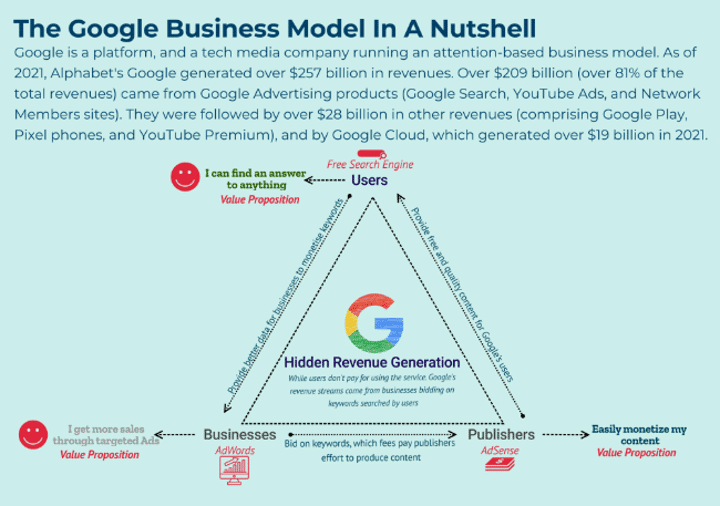
Google is a platform, and a tech media company running an attention-based business model. As of 2021, Alphabet’s Google generated over $257 billion in revenues. Over $209 billion (over 81% of the total revenue) came from Google Advertising products (Google Search, YouTube Ads, and Network Members sites). They were followed by over $28 billion in other revenues (comprising Google Play, Pixel phones, and YouTube Premium), and by Google Cloud, which generated over $19billion in 2021.
In order to create different revenue models, sometimes companies need to break through the traditions in their own industry. Following whatever the industry players have been doing for a long time is probably not going to help. Indeed, you can try to learn from the other industries’ revenue model and see if this can be adapted in your own industry. For example, a bakery shop is usually getting one and only one source of revenue – selling bread to the neighborhood. One small change can lead to a second source of revenue is putting a little flag on each and every bread they sell out. This can be a very good platform for advertising, and thus getting advertising fees as income.

This revenue model is not affecting the traditional source of selling bread (as bread is considered daily necessity) while creating a second stream of income for the bakery shop. And most importantly, this little change is low cost, with big impact. The advertising fee can even be increased if the shop is selling more and more bread.
Here are some useful tips for you:
- Enterprises need to establish a revenue model based on the characteristics and advantages of their own products and services, target market and positioning, and the latest market trends.
- Revenue models change over time. For example, an online application software can attract customers with a “free service” and then add paid features. When the number of customers is large enough, the teaching plan can be launched for both online and offline.